Category Archives: thinking out loud

A View from the Country

Clouds and BarnMy husband and I have lived in the country for almost a decade. I was chatting with another rural dweller yesterday, and we laughed a bit about how our lifestyles haven’t really changed that much with isolation. We are used to staying home. After all, we moved to the country for the peace and quiet and space, and we like nothing better than afternoons digging in the garden and evenings on the porch. Plus, in the case of my husband and I, two introverts married each other, so there’s that.  It’s a good day or week when we don’t have to leave the farm.

We are really semi-rural (I don’t want people imagining us in the middle of nowhere): we live on 18 acres at the edge of a small town. The house dates from the 1850s. The property has several old barns, a ceramic silo whose top blew off in a tornado years ago, and an old outhouse that is being reclaimed by nature. Our town has basic services like gas, milk, toilet paper and liquor, and so far things have stayed open.

But, even if they closed, we would be okay for at least a couple weeks. Our freezer is full of meat, mostly from a local farmer who slaughters a few cows and pigs each year. They also supply us with eggs and are raising a couple milk cows. (Fresh mozzarella, anyone?) We usually have access to goat milk although it isn’t my favorite.

We moved to the country when our little college town of Williamsburg became a retirement mecca, and there were suddenly traffic jams and lines at the grocery store. We both grew up in the country and love the freedom and privacy of living down a long driveway. My own parents escaped the city for the country when I was an infant, and I don’t ever remember a summer without a garden. We ate vegetables fresh and then “put them up,” which meant either canning or freezing. When my fraternal grandmother died, we discovered a basement full of jars: green beans, pickles, jams and jellies. Food was never wasted.
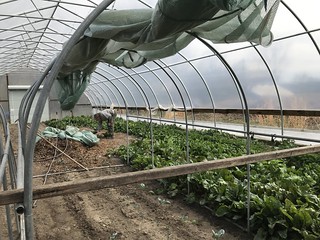
Farm to tableMy husband is retired and raises a fair amount of our fresh vegetables. We are fortunate to have a high tunnel, an unheated green house, where he can start spring crops early. With the mild winter, we’ve been eating spinach and kale for a couple months, and the cabbage and broccoli is coming in. (If you haven’t eaten freshly picked broccoli lightly steamed with butter, lemon and garlic, you have missed out. It is a completely different vegetable than what you find in the grocery store.)

The bumper crop this season has been beets. I love pickled beets and eggs, a favorite from my Pennsylvania Dutch Farm to tablechildhood. My husband does not like beets but grows them for me. I have canned a few jars, roasted some and put them in the freezer (I’m thinking borscht?), and I am going to try beet chips in the air fryer.

The house itself is made for growing food. The south side faces flat fields so gets full sun most of the day. The previous owner–the town doctor who was also a dairy farmer and actually started as the town vet–had put up sliding glass doors along the whole side. It is a natural greenhouse, and we take advantage of the passive solar to heat the house in the winter along with a wood burning stove in our main living area. On a day like today, the doors and windows are open to the world. I can hear birds singing along with early honey bees buzzing. My Farm to tablehusband already has tomatoes blossoming with one small fruit. You do have to tickle them to help them with pollination.

Staples like peanut butter and cleaning products and snacks either get delivered or come  from Dollar General or the IGA grocery store in the next town. The latter has a surprisingly good selection (sun-dried tomatoes, anyone?) but can be pricey. We go once a month or so or we may stop by a “real” grocery store when we are forced off the farm for some errand or other like dentist or vet appointments. We stock up so I was surprised when there was a run on yeast. I guess everyone doesn’t keep a pound in the freezer?

It turns out that my husband and I were made for self-isolation. Ironically, we were just beginning to plan a life of travel off the farm, imagining a sprinter van just big enough for the two of us and our dogs to travel the country.

After hearing stories of city folk fleeing to the country, I jokingly offered up our cottage for visitors who wanted to try it out. Will we start to see a long term migration? And what impacts–both positive and negative–might it bring? Certainly, we would welcome better broadband. But we don’t need much more commerce or entertainment. I guess if my town gets too crowded we can sell the farm and head west, maybe closer to the middle of nowhere.

Choose Carefully: Politics Over Friendship

Since my Twitter rant turned into a somewhat thoughtful blog post, I decided to do the same for a Facebook rant . I think this one is still pretty ranty so take it for what it’s worth. Mostly, let’s be kind to everyone.

Perhaps I am the last person in the world who hasn’t unfriended or unfollowed everyone with whom they disagree politically or religiously. To you, this  post will seem a bit outdated and naive and maybe even dangerous as I haven’t written everyone on the other side off as immoral and unethical.

Forgive me. Despite the political and religious divide in the world, I have attempted to maintain friendships with folks from the whole spectrum. And, while I don’t share overt political posts or rants on social media, I suspect my own politics are pretty clear from what I do share. (Let’s just say a lot of stuff from The Zinn Project and The Equal Justice Initiative.) I will admit to using the mute button liberally.

Mostly, I try not to be judgmental. We all have pasts and stories and cultures that define who we are and are difficult, and perhaps, impossible to shed.  I genuinely care about the people I follow, and I try to put relationship ahead of politics or religion. But, yesterday, as I scrolled through my Facebook feed, two posts, in particular, just seemed incredibly out of line: a ridiculous “I’m just sayin” kind of conspiracy theory post and then one that showed real hatred towards those on the other side. Mean and ugly posts about people like me from people that I regarded as friends. Granted, they did not originate the thought, but they shared it and pretty cleared agreed with it.

One of the women who posted checked in with me via Messenger almost every day as I was recovering from my surgery last year. Yet, her rhetoric in a public forum was really hateful. She genuinely seems to find people like me repugnant. While I am no snowflake, my feelings were hurt. Had she considered me at all before sharing the post? She knows me to be a good person, I think, and must be aware that her post was going to hurtful.  She has chosen politics over our relationship. I considered a confrontation, but I pressed mute for now. It is tempting to try to engage her, but if her ongoing posts and comments are any indication, she does not appear to be open to ideas outside her echo chamber.

I guess I feel a little betrayed: I stuck with these friends even though we disagreed on larger issues because I wanted to know about their lives and support them as friends and even be aware of what others outside my own echo chamber were thinking. Part of the reason I don’t do “those people on the other side are horrible” kinds of posts is because I do care about their feelings. I know I’m not going to change their minds and it would just be hurtful.  How could we still be friends if I took that path. I wonder if these women stopped to ask that question of themselves?

Here’s my plea: can we, just for a little while, focus on what connects us. I love the posts from families about surviving quarantine and doing simple gardening at home. I look forward to the posts from a friend who is asking daily questions about what we are learning or cooking or thinking.

Today, we all shared pics of meaningful art from our homes. Here’s mine: my favorite poem from Wendell Berry seems so appropriate now. It is done as a collage, and I know I purchased it at an art festival in Corolla, NC, a very long time ago. There doesn’t appear to be an artist’s name on it:

If you have managed to maintain any friendships with people with whom you disagree, try reaching out in a positive way. Or at least unmute them for a few days to wish them well.

Be safe out there.


Watching Professionals Have Fun

I have enjoyed watching two sports throughout my life: tennis and figure skating. The end of January was a bonanza month with the Australian Open and the US National Figure Skating Championships. Thanks to the wonder of the contemporary world, I was able to watch a lot of both of them despite not having cable.

As always, I was inspired by their skills, strength and determination. And, when it was all over, I enjoyed watching them have some fun, too. The tennis fun happened at a Roger Federer Foundation fundraiser in South Africa where he played Rafael Nadal in an exhibition match. While they were clearly competing, they were smiling as they did so and even making jokes and a little trash talk. Clearly having fun playing the game to which they have devoted their whole lives:

For the ice skaters, the fun comes after the competition in the skating spectacular where they can dial down the pressure (no required elements, no worries about under rotations), put on some cool costumes and have fun with no thought to competition at all. Certainly, the best example of this was the ice dancing pair of Kaitlin Hawayek and Jean-Luc Baker who skated to Swan Lake:

I wonder sometimes how top competitors keep up the motivation and commitment, and these moments of fun give us a clue: they really love their sport. We see a passion, sheer joy, that goes beyond any superficial desire to win.

Randomly Connected Threads

Sometimes there is a bit of serendipity in my reading and learning. This morning, Tim Stahmer’s post about data mining became a catalyst for that serendipity. He used this photo of the Hope-Katy Mine in Basin, Montana from Wikimedia Commons as a metaphor and mentioned not knowing what might have been mined there. With my new found interest in US geology ala John McPhee, Mine entranceI went out to look and discovered it was gold and silver as they were the two most valuable ores found in the area.

The rich veins formed after molten rock came to the surface, turned into granite that cracked as it cooled, which allowed for the gold and silver to fill in. And all this happened some 81 to 74 million years ago. Geological history is a bit overwhelming at best.

More recent history in the West also fascinates me. The history of Basin, Montana, is one that repeated itself in towns across the West as miners and companies came and went, got out all but the impossible ore, and moved on, creating waves of boom and bust. But, Basin has reinvented itself somewhat as a health town, encouraging people to descend into the Merry Widow Health Mine to inhale radon and drink the pure spring water to cure a whole host of ailments.

In addition to McPhee, my 2020 reading included Tim Egan’s The Big Burn, his history of the 1910 wildfire that burned large sections of Idaho and Montana, destroying several railroad towns. Firefighters fought a losing battle but stories of heroism were born. And here is where this thread connects to the last: a US Forest Service ranger Ed Pulaski saved most of his crew by escaping into an abandoned mine, near Wallace, Idaho, which was partially destroyed in the fire.

Earlier, in the late 1800s, Wallace had been the site of a union strike that led to the wider Coeur d’Alene labor strike. And that ends this journey with my current read: The Women of the Copper Country, which tells the fictionalized story of Anna Clemenc and her labor activism during the Copper County, Michigan, strike in 1913 – 1914.

Geology, history, literature, biography: all these threads come together around the stories of the landscape and its people.


The Origin of Wicked Problems

I learned about Rittel and Webber in my policy course in graduate school. The identified 10 characteristics of wicked problems in their article Dilemmas in a General Theory of Planning, published in 1973. You are fortunate as it is available for free online. If you don’t wish to dive into the article, here is the abstract:

The search for scientific bases for confronting problems of social policy is bound to fail, because of the nature of these problems. They are “wicked” problems, whereas science has developed to deal with “tame” problems. Policy problems cannot be definitively described. Moreover, in a pluralistic society there is nothing like the undisputable public good; there is no objective definition of equity; policies that respond to social problems cannot be meaningfully correct or false; and it makes no sense to talk about “optimal solutions” to social problems unless severe qualifications are imposed first. Even worse, there are no “solutions” in the sense of definitive and objective answers.

And, you’ll be relieved to know that Wikipedia has the Cliff notes (or Spark notes, depending on your age).

I share this research with the classes I teach, including a project management class, where they are generally doing planning in the social sciences, and with my Master’s in Ed students who will become school divisions leaders, often tasked with doing planning. The concept continues to be timely.

In fact, I just started reading a book that uses the concept as a theme. The author attributes is understanding of the concept to a professor but makes no reference to Rittel and Webber. I wonder if it is because the research is so old? At some point, does a concept become commonly understood, an accepted part of the vernacular, so that it is no longer required to cite its creator? I think we need to at least give a nod to the origins for those who might want to learn more and explore the thinking behind the concept.