I am sitting in a workshop in a large school division that is really wrestling with technology. In particular, they struggle, as many schools do, with how to provide access to their students but also how to protect them. They have filtered anything with the word “blog.” However, my blog doesn’t have that word in its URL so I was able to get to it and am testing out adding posts. Hmmm…
Monthly Archives: October 2006
Self directed learning
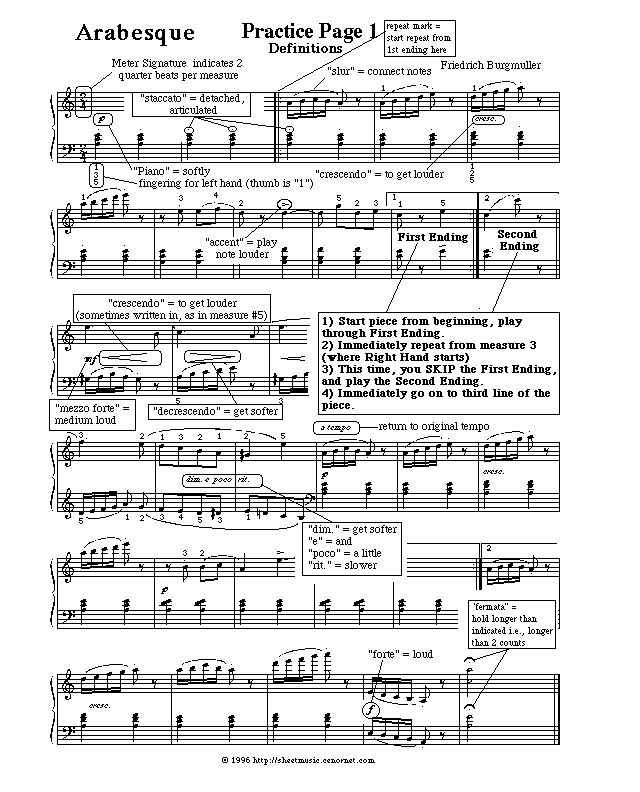
I’ve been trying to figure out how to create a soundtrack for my movie. I downloaded some public domain sheet music. Played around with GarageBand and want to explore it further, but for now, I’m just using my midi controller to play the music straight. At this site, in addition to pdf files, they have annotated sheet music with ideas for how to learn the piece. A good example of how the web can teach subjects that have usually taken place face to face.
Yet Another Example…
Just posted about media literacy in a postmodern world. Browsed a few of my favorite blogs and found a post from Assorted Stuff about a report from Indiana University indicated that The Daily Show with Jon Stewart is just as substantive as the typical nightly news program.
For me, the most important part comes right at the end: “The 2004 elections saw the highest turnout among voters among age 30 in more than a decade. A 15,000-student study released Sept. 22 by the Knight Foundation and J-Ideas found that young people are turning more than ever to programs like Stewart’s for political information.” Media literacy at work…but how many schools filter The Daily Show website rather than using it to discuss current events?
Modern Education in a Postmodern World
This is really the bottom line, isn’t it? We’re clearly living in a subjective postmodern world. Yet, the culture of the classroom still reflects an objective modern world. If I have learned anything from my focus on media literacy over the past few months, it is that we simply can’t afford to keep doing that. It doesn’t seem to matter where I turn, there’s an example. This week, it was Gloria Bolger’s column in US News & World Report.
Bolger takes George Allen to task for clearly suffering from a lack of media literacy skills: “But, hey, don’t feel bad for Allen. He said something awfully stupid, at the very least. He also knew he was talking to a guy pointing a camera at him who worked for his opponent. And he’s supposed to be savvy. So no excuses. But here’s the larger point: The new digital technology has completely changed the face of campaigning, so candidates beware.” I just finished Richard Lanham’s book The Electronic Word and he says that electronic text is changing the face of education. Don’t we just have this sense that things are radically different?
Yet, I hear from my contacts in K-12 that electronic text and video have barely touched the classroom. Schools divisions are filtering because that’s what we did in a modern world. We are leaving it up to the kids to teach themselves about the postmodern world.
Lanham’s Wikis
I know that Ward Cunningham deserves credit for developing the Wiki software. According to the Wikipedia article about WikiWikiWeb, he began development in 1994 and published the first version in 1995. I wonder if he had read Lanham’s The Electronic Word, published in 1993. In Chapter 5, Lanham envisions what a typical freshman composition course would look like if we really took advantage of the electronic word:
“Our new electronic nontext-nonbook will be ‘published’ in a different way, too. It will be a dynamic, open-ended information system, critiqued and updated on a daily basis by its users, both local and distant, both teacher and student. It will be ‘published’ on telephone lines–if the regulatory environment permits it–or through a fiber optic ISDN (Integrated Services Digital Network) of some sort. Systemic textbooks will grow, take on local coloration and emphasis, mutate into new forms of collective cultural enterpreise, as they become part of that gigantic structure of 30,000-odd electronic bulletin boards already out there. Not only the idea of single authorship will be knocked for a loop, but royalty payments, copyright law, and academic merit badges for publication as well…These systems will carry, too, a remarkable charge of self-teaching power that will force renegotiation of the teacher-student contract–a renegotation already reported by those teaching in networked computer classrooms.” (p. 126).
Certainly sounds like a Wiki to me!